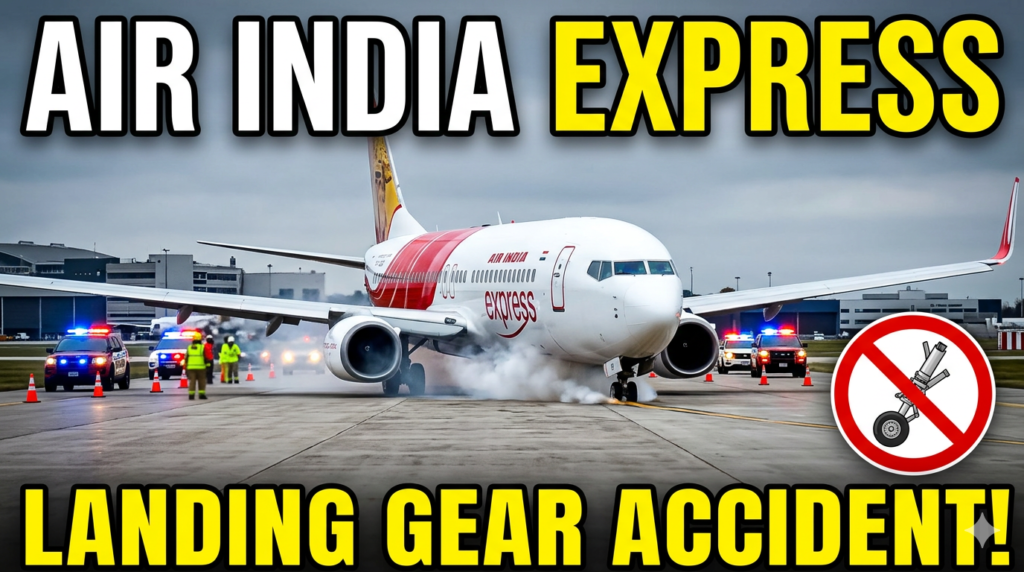
On March 11, 2026, Air India Express flight IX938, a Boeing 737 MAX 8 travelling from Hyderabad to Phuket, experienced a significant landing incident at Phuket International Airport. The aircraft suffers a “hard landing,” resulting in the collapse of its nose landing gear and one burst tyre.
Incident Overview
The flight, carrying 133 passengers, touched down at approximately 11:24 AM local time. Reports suggest that the aircraft may have hit the runway with excessive vertical force, causing the nose wheel to break off and the aircraft to skid briefly before coming to a halt on the tarmac.
Key Details
Aircraft: Boeing 737 MAX 8 (Registration: VT-BWQ).
Location: Phuket International Airport (HKT), Thailand.
Outcome: All 133 passengers and crew members were safely evacuated; no injuries were reported.
Operational Impact: The incident forced a temporary closure of the runway for nearly six hours to allow for aircraft removal and safety inspections.
Response and Safety Protocols
When the Landing gear failure incident happened , airport emergency response team were immediately activated. Passengers were evacuated directly on the runway and transported to the terminal building. Air India Express confirmed that the crew followed all standard safety protocols during the whole event.
Investigation & Context
The Directorate General of Civil Aviation (DGCA) and Thai aviation authorities are expected to conduct a thorough investigation into the cause of the “hard landing” that led to landing gear failure. Interestingly, reports indicate that both nose wheels had been replaced as part of routine maintenance on March 8, 2026.
This event follows a series of recent safety-related incidents for the airline, including a mid-air emergency involving Flight IX 613 at Tiruchirappalli and a runway excursion during heavy rain in Mumbai earlier in late 2025.
For travellers, this serves as a reminder of the rigorous safety engineering built into modern aircraft—such as the landing gear’s ability to fail “deliberately” to protect the main fuselage—and the efficiency of emergency response teams in ensuring passenger safety during rare mechanical failures.
Preliminary Findings & Focus Areas
“Suspected Hard Landing with Bounce”: Officials confirmed the Boeing 737 MAX 8 experienced a heavy landing on Runway 09, which reportedly caused the nose wheels to detach entirely from the aircraft.
Maintenance History: A key point of the investigation is that both nose wheels were replaced just three days prior, on March 8, 2026, as part of routine maintenance. Investigators will examine if this maintenance played any role in the failure. But there is very less chance of pre wheel failure as we can clearly see in Video that there is some issues before touch down only, when the aircraft touched down then wheel failure is observed.
Technical Data Review
The investigation will analyze the flight data recorder (black box), pilot reports, and runway conditions to determine if the primary cause was a mechanical failure, environmental factors (like windshear), or operational factors.
Descent Rate
Early reports suggest the aircraft touched down with excessive vertical speed, potentially exceeding the standard safety limit of 600 feet per minute.
Runway Reopening
The airport’s sole runway was temporarily closed for approximately six hours following the incident. It reopened to all traffic around 6:00 PM local time on March 11, 2026, after the disabled aircraft was towed to a bay and the runway surface was cleared of debris and inspected for safety.
Impact on Flights: The closure was significant, affecting 97 scheduled flights at Phuket alone and disrupting a total of 165 flights across various Airports of Thailand (AOT) facilities.
Current State: Travellers should expect normal flight schedules today, though some minor knock-on delays may persist from yesterday’s heavy diversions to Krabi and Surat Thani.